
Cory's Reads #52: Double Features
Programming my top 50 films of 2025...and wishing you a happy new year!

2025 is in the books, but it’s the movies we tend to obsess over here at Cory’s Reads.
I tend to avoid discussions of whether or not a year is a “good” year in film, as much as that question seems to dominate the discourse this time of year. If you watch enough movies, every year is a good movie year. I watched 105 new releases in 2025, and I liked at least half of them to varying degrees. Of course, the average consumer does not watch nearly as many films in a given year, so perhaps the question of a year’s overall cinematic quality is more precisely concerned with the experience of the masses.
In either case, I feel comfortable regarding 2025 as a memorable year for cinema, with original films like Sinners, Weapons, and Marty Supreme becoming not only box office sensations, but also genuine cultural touchstones. Perhaps I am speaking from my LA-based bubble, but I sense a genuine excitement about film amongst the general public that had been lacking in recent years.
(If anything, LA could use that kind of excitement — the town’s economic reliance on the still-struggling industry hangs an anxious cloud above this city of cinephiles.)

Cinema-as-artistic-expression and cinema-as-economic-engine remain two distinct phenomena. I sometimes wish I could separate my own economic dependence from the health of an artform I love so deeply. It sure would be nice to simply watch movies for the fun of it!
Alas, I am an overthinker to my core, and so as I look back at my 50 favorite films of 2025 below, I do so with an unsettling awareness of the financial pressures these filmmakers face, but also a cautious optimism about the range of their artistry and their insight.
What strikes me most about the 2025 catalogue is the thematic throughline one could draw between almost every film on this list. Critiques of capitalism and American exceptionalism are nothing new, but these frustrations came to the fore in 2025 with an alarming urgency, reaching uniquely depressing depths in the process. It is upsetting if also unsurprising that so many movies 2025 in lamented parenthood — motherhood1, in particular — and that so many others questioned compatibility between partners2. In September, I wrote about “Recession Indicators” — when movies pick apart the family unit, they are not just examining personal relationships, but rather the viability of those relationships amidst political and economic upheaval.
In an attempt to arrive at a unifying theory of 2025’s cinematic stressors, I have divided my top 50 films of the year into a set of 25 double features, pairing films together based upon their thematic or narrative cohesion. In most cases, I truly believe these films richly inform one another, and would make for a great double feature. Let me know if you decide to program any of these for yourself, or if you think I missed any opportunities to double up on some similar ideas.
REMEMBER — these double features are made up of my own personal top 50 films (exact rankings are denoted in parentheses below). That means no Jay Kelly or Sentimental Value (two films that pair nicely in their own right), no Frankenstein, no Train Dreams, and absolutely no Wicked: For Good.
You can scroll down to find the full list beneath the article. Thank you as always for reading, and happy new year!
Weapons (44) x The Perfect Neighbor (17)
We begin by pairing one of the year’s most popular films with a powerful documentary that managed to avoid the usual fate for Netflix nonfiction. Zach Cregger’s Weapons follows the inexplicable disappearance of all but one child from Ms. Gandy’s (Julia Garner) grade-school classroom in the small town of Maybrook, PA. Even as it delves into witchcraft and the supernatural, the film stays grounded in very real anxieties around how we can keep our children safe. Those missing children all woke up at 2:17 AM, walked out their front doors, and never returned (well, until the end of the movie). Under their own roofs, the auspice of their parents, those kids were not safe. At one point, the horror of that reality manifests in the dreams of Archer Graff (Josh Brolin), who sees a giant AR-15 floating above a suburban home, evoking the school shootings that have all too often borne out the notion that American children may be in danger, even in their own schools.
Geeta Gandbhir’s The Perfect Neighbor transcends its true-crime trappings by using exclusively primary sources, mostly bodycam footage from the police officers who arrived on the scene to mediate the regular disputes amongst a small Florida neighborhood, in which loner Susan Lorincz often called the cops on the local children, who were simply using the area’s limited green space for play. The film ultimately tracks the chronological events leading up to the tragic death of Ajike Owens, for which Susan Lorincz was later convicted of manslaughter. The escalating tension in The Perfect Neighbor is as uneasy as any horror or thriller film in 2025, and the erosion of community in both Gandbhir’s film and Weapons is a harrowing signal that we may no longer know our neighbors, and it may be our children who have to pay the ultimate price.
Predators (9) x The Alabama Solution (48)
2025 was a particularly strong year for documentary filmmaking, and so this next double feature consists of two docs. David Osit’s Predators is one of the most challenging films of the year, interrogating the legacy of Chris Hansen’s NBC series To Catch a Predator. Pedophiles and sex predators are rightfully some of the most vilified individuals in our society, and Osit takes on a rather thankless task in questioning whether the packaging of their humiliation for our entertainment does more harm than good. For many people, including victims interviewed in this very film, there is genuine catharsis in watching Hansen entrap and shame such sick perpetrators. But Osit raises several valid concerns around not only the sadistic nature of To Catch a Predator — as well as its more recent online copycats — but also the fragile relationship the show forged with local law enforcement. Can or should justice be carried out in front of a national audience? Once upon a time, Hansen and NBC had their hearts in the right place — Predators may even pair well with our first double feature, tapping into perhaps the deepest fear we have for our children — but Osit brilliantly illustrates how the show soon lost its way, applying its addictive formula across all kinds of cases without any regard for safety, rehabilitation, or forgiveness.
Legendary documentarian Andrew Jarecki has always been interested in forgiveness, and while his neoliberal sensibilities have always handicapped his work in my mind, The Alabama Solution is a searing indictment of the American prison system and its utter disregard for those who inhabit it. Like The Perfect Neighbor, Jarecki’s film includes a great deal of primary footage, mostly recorded in secrecy by incarcerated leaders via smuggled cell phones. These clips reveal an absolute systemic failure within the Alabama prison system, where inmates are barely fed, their living conditions barely maintained. Jarecki and his co-director Charlotte Kaufman interview the family of Steven Davis, who was beaten and killed by prison guards at the Donaldson Correctional Facility. Davis was in prison on a probation violation related to drug charges, and while an internal investigation tried to paint him as a murderous danger to the cops who killed him, there is little evidence to support the idea. If Predators proves a bit too controversial for some viewers in its capacity for forgiveness, The Alabama Solution should make clear that our prison systems are not built to support or even punish convicted criminals, but rather dehumanize them altogether.
Nuremberg (31) x The Voice of Hind Rajab (40)
As we continue to track 2025 conversations around the justice system in the United States and beyond, a somewhat surprising pair of films emerges. James Vanderbilt’s Nuremberg struck me as a bland period drama when it first crossed my radar, but Vanderbilt’s script, along with an excellent leading performance from Rami Malek as psychiatrist Douglas Kelley, makes this two-and-a-half hour film surprisingly propulsive. Nuremberg is more than just a recap of the events surrounding the trials that would set the standard for international criminal law. It is a powerful reminder of why the justice those trials brought about may have been insufficient in ensuring the atrocities of the Holocaust never happen again.
Indeed, we are witnessing another genocide in Palestine today, and Kaouther Ben Hania’s The Voice of Hind Rajab is an undeniable testament to the ongoing horrors in Gaza and the West Bank. If you are unfamiliar with the film, you may at least recognize its namesake. Hind Rajab was a five-year-old Palestinian girl in the Gaza Strip murdered by Israeli forces, who had already killed six of her family members and two paramedics coming to her rescue. Rajab and her family had been attempting to flee Gaza City when the Israeli soldiers began firing into their vehicle. As the young girl hid inside the car, she dialed the volunteer emergency workers at the International Red Crescent. The voice recording of that call went viral, and became a heart-wrenching symbol of the young girl’s bravery amidst such terror. Ben Hania’s film uses that same recording to recreate the events of that day from the Red Crescent’s perspective. The film is not entirely successful in fleshing out Rajab’s story beyond its evident evil, but I am grateful that we have filmmakers like Ben Hania creating documents of this genocide that may one day serve crucial in cementing its perpetrators as historical villains, much like Hermann Göring and his compatriots in 1946.
Superman (27) x Cover-Up (28)
As the genocide in Gaza rages on, we can only hope that more and more filmmakers are willing to attest to such horror in the coming years. And while Superman director James Gunn publicly denied any parallels between the situation in Palestine and his film’s own instance of imperial evil, I maintain that the similarities are too obvious to ignore. The fictional country of Boravia’s invasion of Jarhanpur maps all too neatly onto the settler colonialism of the Middle East, and while the comic book adaptation never quite proffers a coherent ideology on the situation, it’s refreshing to see a mainstream blockbuster engage with a genocide that most others would gladly ignore.
Of course, that kind of curiosity feels right at home in a film centered around enterprising journalist Clark Kent. Superman is a colorful action romp like any other entry in the superhero genre, but it is also a pretty solid journalism movie! It therefore forms an unexpected pairing with Cover-Up, the latest film from Laura Poitras, perhaps our greatest living documentarian, and her co-director Mark Obenhaus. Poitras’ new film may be the definitive documentary on the art of journalism, inviting its subject Seymour Hersh to reflect on his career’s most iconic investigations, spanning the Vietnam War, Watergate, Abu Ghraib, and even the events in Palestine today. But what makes Clark Kent and Seymour Hersh such an appropriate duo is not what they get right, but rather what they have gotten wrong. In one of Cover-Up’s most illuminating moments, Hersh admits that his personal relationship with Syrian president Bashar al-Assad had clouded his judgment whilst reporting on the 2013 Ghouta chemical attacks, which Hersh had incorrectly attributed to the Syrian rebel forces, rather than al-Assad’s government. To this day, Hersh remains highly protective of his sources, prioritizing their anonymity. Poitras is the perfect fit to direct such a story, which indirectly sheds light on her complicated reporting on such figures as Edward Snowden and Abu Jandal over the years. Superman similarly finds Clark Kent leveraging his Superman persona to pursue nebulous leads or put forth shaky sources in his fight against the occupation in Jarhanpur, powered by information and the written word as much as it is laser beams and super strength. At times, the depiction of journalism in Superman can seem old-fashioned, but Hersh’s story is a necessary reminder that such journalism does, and should, still exist.
Avatar: Fire and Ash (26) x Mission: Impossible — The Final Reckoning (20)
The specter of genocide rightfully looms over many films today, but director James Cameron has been concerning himself with the mass murder of indigenous populations since first welcoming audiences to Pandora with Avatar in 2009. Nearly twenty years later, Avatar: Fire and Ash brings the story of Jake Sully and his Na’vi family to a close…for now. This third entry in the franchise is likely the weakest of the bunch, but it somehow continues to up the ante visually, and its rich family dynamics remain as poignant as ever. The film may lack the structural sturdiness we typically expect from Cameron, rehashing several familiar beats en route to a rather safe and unsatisfying conclusion, but it does expand upon its once black-and-white themes by asking more probing questions around environmental rights and cultural assimilation. It can be easy to forget after spending so many films embedded amongst the vibrant pastures and communities of Pandora, but Fire and Ash reminds us that humanity’s future has always hung in the balance in this franchise.
For those with a little over six hours to kill, Fire and Ash would form a nice double feature with another imperfect blockbuster in Mission: Impossible — The Final Reckoning. Both films include some of the highest highs you will find whilst watching a movie this year — fluid action set pieces, death-defying stunt sequences, Hayley Atwell and Oona Chaplin — but also threaten to buckle under the weight of their own storytelling at any moment. The Final Reckoning offers its own vision of global catastrophe, one which I found oddly resonant with our current AI-fueled climate. “The Entity” may sound like a bad B-movie from the 1980s, but I think it makes for an engrossing antagonist in this final bow from Ethan Hunt and the gang, standing in for the technological race to the bottom that has already fomented misinformation and division on both a personal and global level. Audiences seemed to recoil at the idea that an AI could gain sentience and turn all the world’s nuclear powers against one another, but that still doesn’t seem too crazy to me.
One Battle After Another (1) x The Phoenician Scheme (5)
One Battle After Another is the best movie of the year for several reasons, but arguably my favorite thing about this latest masterpiece from Paul Thomas Anderson is its simplicity. Indeed, One Battle invites complex and uncomfortable conversations around race, parenthood, and the fine line between revolution and reality. It is one of the great meditations on the so-called Current Moment, but it is also an airtight thriller in the tradition of the aforementioned James Cameron, evoking The Terminator 2 as much as it does The French Connection or Casablanca. Sean Penn turns in the performance of the year as Colonel Stephen J. Lockjaw, a leathery white nationalist whose pursuit of a greater purpose would forever be undermined by the fact that he is, at his core, deeply pathetic. Lockjaw is truly a villain for our times.
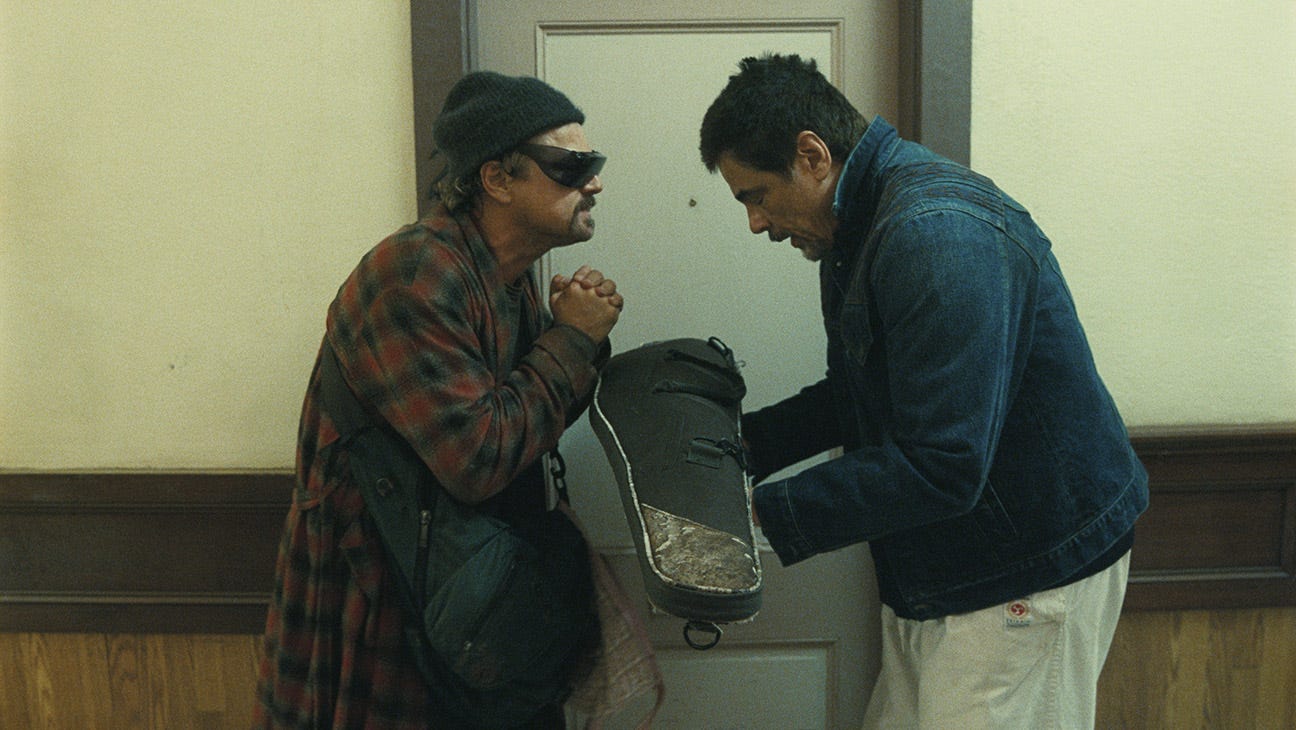
And yet, it is Benicio del Toro who bridges One Battle After Another with the other side of this double feature: Wes Anderson’s The Phoenician Scheme. I fear we have begun taking the auteur for granted, his twee aesthetics betraying their true puzzle-box nature. Besides One Battle, Anderson’s new film may be the year’s greatest evocation of our current moment, and if Lockjaw was not already the year’s most repulsive riff on the sitting president, than Benicio’s Zsa-Zsa Korda would almost certainly claim that title. I am glad Benicio is receiving awards recogniton for his work in the former film, but his performance as Korda may be my favorite of his, a deceptively deep interpretation of the wealthy loners who have assumed their precarious positions atop our global power structures, sacrificing all capacity for love and humanity in the process.
Zootopia 2 (23) x Mickey17 (35)
If the alien humanoids of Pandora do not garner your sympathy, perhaps a pair of different 2025 blockbusters articulate a more urgent vision of violent displacement and its acceleration under contemporary capitalism. Naturally, Disney’s Zootopia 2 fits such a description, following in its predecessors footsteps by offering a surprisingly mature and urgent reflection of our reality, reimagined through an entirely anthropomorphic society. The original Zootopia mapped issues of police brutality, white supremacy, and the war on drugs onto an urban metropolis — the franchise is referred to as Zootropolis in certain European territories — populated entirely by talking mammals. The sequel similarly zeroes in on relevant contemporary crises, this time turning to issues of gentrification and displacement. Across both movies, I am impressed with the clarity of these attempts to engage young viewers in difficult conversations about the issues affecting America’s urban centers, not to mention geopolitics worldwide…the reptilian cause evokes the Free Palestine movement as much as it does developments everywhere from Bushwick to Berkeley.
In Zootopia 2, reptiles are long-time victims of prejudice and disregard, but they are never coded as a single culture or race. If anything, the multicultural creativity of the Zootopia franchise makes its examples of prejudice seem particularly absurd, much like our own. Legendary Korean director Bong Joon Ho set out to make a similar critique with Mickey17, a sci-fi slapstick comedy whose broad satire is still fiery enough to justify the film’s juvenility. In this film, the oppressed group is not quite anthropomorphic. They are alien creatures know as Creepers, unable to speak and resembling large insects. Over time, they are revealed to have a complex society and familial structure, much like humans. Therefore they do not deserve to die, or to lose their homes, or to be drained for resources…right? Bong’s point in Mickey17 is rather shallow relative to Zootopia 2 or Avatar: Fire and Ash — The Tulkun are likely a much more resonant riff on this sort of thing — but he still makes a very funny movie filled with lots of f-bombs and a career-best performance from Robert Pattinson.
Sinners (2) x The Testament of Ann Lee (6)
For an animated film, Zootopia 2 develops a wonderfully diverse world, cleverly mapping all kinds of animal species onto recognizable subcultures from our own world. A sense of community permeates the film, but no 2025 film captured the vibrancy and necessity of a tight-knit community like Ryan Coogler’s Sinners, which simultaneously complicated the idea by asking difficult questions around cultural assimilation, appropriation, and appreciation. Coogler brilliantly weaponizes genre norms in Sinners, repackaging typical vampire tropes in a story concerned with cultural vampirism and the ways in which Black art has evolved amidst a landscape often prepared to feast on its downfall. That art in this particular case is music — the blues, to be exact — and composer Ludwig Göransson teams up with a host of incredible songwriters to craft a soundtrack worthy of one of the year’s very best films
In a vastly different context, Mona Fastvold’s The Testament of Ann Lee also interrogates the presence of music within a film, leaning on the prototypical trappings of an old-fashioned movie musical, whilst casting doubt on where each musical number ends, and where the characters’ religious practice begins. Each song in Ann Lee doubles as prayer, their lyrics pulled from hymns originally scribed by members of the Shaker movement, whose founding the film documents with faithful exaltation. Fastvold (as well as Amanda Seyfried in one of the year’s best leading performances) invites the audience into an experience of worship. By mapping such a traditional form of entertainment and performance onto a more contemporary understanding of those very same things, Fastvold’s film becomes not only an expression of a once-proud faith, but an ode to moviegoing as its form of worship. In both her film and Coogler’s, viewers will be hard-pressed not to feel united with their fellow moviegoers.
Blue Moon (18) x Eephus (50)
Few filmmakers evoke a sense of community more than indie film legend Richard Linklater, and Blue Moon could easily slot alongside Sinners and The Testament of Ann Lee as yet another exploration of music and artistry amidst a distinctive period in history. But whereas those two films considered a community’s perseverance against external forces, Blue Moon follows a lone figure in Lorenz Hart, whose alienation from his peers, including close collaborator Richard Rodgers, in 1943 NYC threatens to undermine, or perhaps even cement, his status as a creative genius. Ethan Hawke turns in one of the year’s best performances as Hart, an eccentric loner who holds court at the bar in Sardi’s Restaurant, pontificating about romance, death, literature, theatre, and so on and so forth. Through Hart, Linklater taps into a New York theatre scene on the brink of transformation, about to birth the much more fruitful partnership between Rodgers & Hammerstein, and to share the spotlight with Hollywood in the broader American cultural imagination.
Carson Lund’s Eephus takes fairly explicit cues from Linklater, settling into a reflective hangout mode as it similarly gives space to a recreational baseball team of misfits, playing their final game on the local field before it gets torn down to build a school. Like so many great Linklater movies, Eephus excavates the elasticity of time to great effect, allowing its ball players to hold on to this never-ending (and uneventful) game as one last moment of Zen.
The Secret Agent (3) x Resurrection (14)
The Secret Agent might be the year’s most evocative film, recreating 1970s Recife with impressive period detail. Kleber Mendonça Filho’s film is many things, including a love letter to the cinemas he once frequented in the Brazilian city, as well as a political thriller documenting the division sowed by the country’s dictatorship. Mendonça weaves together these elements and many others to create a powerful portrait of a nation in transition, and Wagner Moura gives a quietly assured performance that will garner him several deserved nominations all awards season long. The Secret Agent is especially clever in regards to pop culture and the way it shapes the stories we believe — or choose to believe — about our sociopolitical reality. Cinema therefore becomes a tool of both propaganda and liberation for Mendonça.
Only one other film expresses such fascination with the medium of film in 2025: Resurrection, from Chinese auteur Bi Gan. I cannot claim to understand most of Resurrection, but I do know how the film made me feel: calm, anxious, sleepy, excited, inspired, empowered, insecure and uncertain. Bi’s film is a smorgasbord of cinematic offerings, not to mention a display of technical mastery. It is a mirror for its audience, an invitation to find your place within the cinematic history it so athletically traverses.
Videoheaven (22) x Freaky Tales (20)
If The Secret Agent and Resurrection are thoughtful meditations on film history, Videoheaven and Freaky Tales are overt love letters to the cultural milieu that has sprouted up around that history. To his credit, Videoheaven Alex Ross Perry puts forth several profound insights within his documentary/video essay about the complete history of video rental stores and their depiction in pop culture. Had the film come out just a few months later, Perry likely would have made room for the video store sequence in Freaky Tales, which features one of the best cameos of the year. Freaky Tales is a high-octane 80s pastiche, a drastic departure from the quiet indie dramas that Anna Boden and Ryan Fleck have built their reputation around over the last two decades. It’s the kind of film that rarely works for me, but this one is made with such love and kinetic energy, I can’t help but count it among my favorite films of 2025.
Nouvelle Vague (25) x Megadoc (34)
The filmmaking process itself also figured heavily into at least two films in 2025, including yet another project from Richard Linklater. Nouvelle Vague is more than just a loving ode to Breathless and the cinematic rebels who made it. By recollecting the French New Wave movement in 1950s Paris — and adopting some of its key sensibilities — Linklater similarly reflects on film history and his place within it. It is hard to watch Nouvelle Vague without thinking about Linklater’s own filmmaking process, both on this film and others.
Of course, the most delicious elements of Nouvelle Vague stem from the chaotic production it is aiming to recreate. But no film captures the insanity of a cursed — and occasionally inspired — film production like Mike Figgis’ Megadoc. Embedded within the production on Francis Ford Coppola’s much maligned Megalopolis, Figgis wisely points his camera at the chaos and simply lets one of the year’s best comedies play out before our eyes. The onset feuds between Coppola and Shia LaBeouf need to be seen to be believed. By the time Megadoc concludes, it is hard not to wonder if we have just watched a proper documentary, or a bizarre piece of performance art from a fading visionary.
Marty Supreme (13) x The Mastermind (12)
If Nouvelle Vague and Megadoc are the stories of ingenious iconoclasts and the singular art that can come from empowering these assholes, these next films consider the destruction such figures often leave in their wake. Marty Supreme is one of the most popular films of the year, and for good reason. Timothée Chalamet is electric as Marty Mauser, a smart-mouthed 22-year-old Jewish New Yorker whose prowess as a ping-pong player has endowed him with great ambition, and even greater self-righteousness. Every wisecrack about the Holocaust and Hiroshima makes Marty less and less likable in the eyes of the audience and those around him, and yet he maintains an irresistible charm in spite of it all. His narrow-mindedness blows up marriages, enterprises, and a literal gas station, and it might even spell trouble for Marty’s future child. Still, there is something recognizable and admirable about Marty’s hustle. His pursuit of greatness brings out a deeper passion for life that contrasts with another 20th century scumbag: J.B. Mooney, of The Mastermind fame.
Josh O’Connor turns in another one of 2025’s great performances as J.B., a much more mild-mannered hustler whose alleged love of fine art drives him to steal four Arthur Dove paintings from his local museum in Framingham, MA. Removed from the chaos of the big city in Marty Supreme, J.B. lives a slow and mostly boring life. He lacks Marty’s charisma, and probably even his ambition. Neither of these men are the mastermind that the latter film’s title might suggest, but J.B. proves particularly inept in planning this art heist. As his friends and family lament his lack of ambition, J.B. takes solace in the fact that he is surely pursuing something meaningful. After all, going into hiding once he is publicly identified as the thief was all part of the plan…right? Kelly Reichardt’s latest masterpiece culminates in one of the year’s great endings, in which J.B. is indirectly punished for his crimes. Both Reichardt and Marty Supreme director Josh Safdie sketch a vivid portrait of mid-century Americana, allowing their protagonists to come into direct conflict with the political crises of the time, no matter their ambition or their aimlessness.
It Was Just an Accident (11) x Roofman (29)
The Mastermind likely features my favorite ending of 2025, but It Was Just an Accident is a close second. Jafar Panahi’s most harrowing film yet is also his most joyous, a slapstick comedy about an Iranian man who has been kidnapped by a group of activists who claim he once tortured them during their imprisonment. As the group grows less and less certain that their hostage is who they say he is, their plans for him begin to diverge. Panahi’s lo-fi approach to filmmaking has often been necessitated by the sanctions he has faced from the Iranian regime, but it also has allowed him to locate a deep humanity within the Iranian people. It Was Just an Accident is no exception, identifying in its colorful cast of characters a love of their country, and a desire for it to restore safety for all.
You would be forgiven if you sat down for the Palme d’Or winner expecting to cry rather than laugh, just as you would be forgiven if you expected the inverse from Derek Cianfrance’s Roofman, which offers its own textured slice of turn-of-the-century Americana. Of course, fans of Cianfrance’s work likely could have predicted that the film sold as kooky crime caper starring Channing Tatum would actually be a moving melodrama about a well-intentioned father who just cannot get out of his own way. Like Marty Mauser and J.B. Mooney, Jeffrey Manchester has a particular set of skills that could serve him quite well in his life. He just chooses to put all his brainpower towards a life of crime. Kirsten Dunst gives one of the year’s best supporting performances as Jeffrey’s love interest Leigh, a tender-hearted Toys R’ Us worker whose willingness to see the best in people is both her greatest strength and weakness. Roofman and It Was Just an Accident form a powerful pair of films that end a far cry from where they began.
Magazine Dreams (19) x The Smashing Machine (33)
Perhaps much to the chagrin of female audiences, troubled men will always be in vogue at the cinemas. As we continue our tour through this ever-revolving gallery, I introduce to you two of 2025’s most musclebound films in Magazine Dreams and The Smashing Machine. Indeed, biceps and deltoids nearly fill the entire frame across both of these films, each of which centers on a burly bruiser whose relationship with his own violence and aggression may be his undoing. In the case of Magazine Dreams, Killian Maddox (persona non grata Jonathan Majors, in an undeniably excellent performance) is obsessed with bodybuilding. It consumes his life, which otherwise consists of caring for his grandfather, the lone responsibility for a social outcast like Killian. He struggles to keep his depression and anger in check, lashing out in public spaces and damaging his own body as a result. It’s a grueling film that can feel legitimately unsafe to watch at times, particularly with the knowledge of its star’s troubled offscreen existence.
It pairs perfectly, however, with Benny Safdie’s The Smashing Machine, which could just as easily pair with Marty Supreme, as both brothers chose to make their solo debuts with sports dramas about men who can’t help but hurt the women in their lives. Dwayne “The Rock” Johnson gives a career-topping performance as Mark Kerr, a mild-mannered guy who just so happens to be a tour de force in the UFC ring. But like Killian, he struggles to compartmentalize the aggression asked of him onstage or in the ring, and the big softie grows increasingly irritable and dangerous as a result.
Sirát (24) x Warfare (42)
If you are anything like me, you love a feel-bad movie, and few films in 2025 left me feeling worse than Oliver Laxe’s Sirát. It is fair to wonder whether Laxe’s EDM-addled odyssey through the Moroccan desert is all that productive beyond its shock factor, but that shock is so gripping and immersive, it maintains value purely as an experience, evoking the “all-at-onceness” that comes from the best music, art, and drugs. And if it is an experience you are after, you will not find a louder one than Warfare, from Alex Garland and co-director Ray Mendoza. Even more so than with Sirát, I question the value of a film like Warfare, a fairly dispassionate recreation of Mendoza’s real-life experience as a Navy SEAL in Ramadi, Iraq. Warfare is a technical marvel, each image brilliantly and viscerally composed. But any film about the U.S. military is likely to leave a bad taste in my mouth, especially one as brutal as Warfare. Still, there is some very fine filmmaking on display across both films here.
Eddington (4) x No Other Choice (16)
Speaking of dread, the master of dread himself, Ari Aster, delivered perhaps the most essential film of 2025 with the COVID-19 satire Eddington. Each passing day has only cemented Eddington more and more as a precise and urgent reflection of our present reality. Aster identified a particular brand of American violence, one that will only elevate the perpetrator in a society prepared to not only run to their defense, but to evangelize them in the process. I wrote about the film earlier this year, but its pairing with Park Chan-wook’s No Other Choice here has less to do with the lens it holds up to the United States, and more to do with its clever framing of cell phones and technology. Until Park’s film came along to close out 2025, Aster held the belt for the best use of cell phones on film, certainly for the year but perhaps across the entire history of the medium. Now the Hereditary director will have to share that title with the Korean auteur, the rare filmmaker who uses the technology to ramp up the tension of a scene, rather than diffuse it. For both Aster and Park, cell phone screens are portals into an alternate reality, sometimes one that more closely resembles the truth than our immediate surroundings, but more often than not it is a glowing omen of the harsh world to come. In both Eddington and No Other Choice, violence emerges as a valid means to an end, so long as it is contained within the 6inch display of an iPhone 15.
Relay (39) x Lurker (37)
Of course, most filmmakers try to bypass cell phones wherever possible. And I can hardly blame them. They tend to threaten any narrative stakes, and cinema already offers an entire arsenal of artistic tools. My favorite of those tools, when leveraged appropriately, is sound. It’s an aspect of film we take for granted, until a film exploits it as an essential component of its storytelling. For whatever reason, Riz Ahmed has developed a knack for appearing in such films over the years. Sound of Metal is among my all-time favorite films of the 21st century, but the 2025 thriller Relay from David Mackenzie is another nifty contribution to that particular canon. Ahmed plays Ash, a vigilante broker who facilitates the safe exchange of information between whistleblowers, the media, and the companies they expose. It is a juicy premise that arguably relies on our familiarity with Ahmed from Sound of Metal. Ash is not deaf, but we might believe he is for the first third of the film. After all, he uses a relay service for the deaf to maintain anonymity during his mediations. Soon, his careful monitoring of Sarah Grant (Lily James) demands that he move beyond the Tri-State Relay Services, and follow her every move within precarious proximity. Relay is a taut thriller that (outside of an ill-advised late-game twist) earns its place alongside corporate thrillers like Michael Clayton and Margin Call.
Ash may be a lurker in his own right, but his noble motives are a far cry from Matthew’s (Théodore Pellerin) in Alex Russell’s directorial debut Lurker, which also riffs on classical thriller tropes in a uniquely modern context. Pulling from his background as a journalist and Brockhampton collaborator, Russell proves quite perceptive about the allure of fame, and the surreal pull that a powerful person’s orbit can often have on those around them. The high-stakes danger in Relay is still present in Lurker. It’s just, fittingly, lurking beneath the surface…bubbling inside a desperate drifter like Matthew, whose creative ambition, nay obsession, overrides any shred of self-awareness he may have had.
Jimmy & Stiggs (43) x Peter Hujar’s Day (15)
COVID-19 gave us countless single-location films, many of them pretty innovative and great.3 Jimmy & Stiggs was birthed from that very era, but turning your apartment into a neon blood-soaked alien spaceship unsurprisingly takes a little longer than some other single-location sets. The latest film from Joe Begos (Jimmy) and his close collaborators Matt Mercer (Stiggs) and Josh Ethier (the editor on the film, as well as that one guy being interviewed in the parking lot) therefore finally arrived in 2025, courtesy of Eli Roth, and the result is a psychedelic and violent romp about creativity, friendship, and getting really, really, really fucked up.
But perhaps the best single-location film about creativity, friendship, and getting only slightly less fucked up is Ira Sachs’ Peter Hujar’s Day, starring the terrific duo of Ben Whishaw and Rebecca Hall. Whishaw gives one of the year’s best performances, reciting the actual manuscript of a conversation photographer Peter Hujar had in 1974 New York City with his longtime friend Linda Rosenkrantz, who Hall captures as a patient and attentive listener. At just 76 minutes, Peter Hujar’s Day barely qualifies as a feature film, but Sachs directs the shit out of this movie. There is nearly as much visual flair on display here as there is in Begos’ maximalist affair. Never has one long conversation looked or sounded more interesting.
The Knife (49) x Bring Her Back (45)
While we are discussing some of the more underseen independent films of 2025, allow me to suggest Nnamdi Asomugha’s The Knife once more. It is also a single-location film of sorts, a tight and tender thriller about a Black-American family whose seemingly innocent encounter with a home intruder brings them into sudden conflict with the local police, namely Detective Carlsen (Melissa Leo), who arrives with all kinds of preconceived notions about what a Black father can and cannot do to protect his family. It’s an intriguing premise that has only taken on greater meaning in recent months, and I hope audiences find their way to this film one way or another. But if there is one other film in 2025 that deserves the title The Knife even more, it might be Danny and Michael Philippou’s Bring Her Back, which features one of the most shocking and disgusting uses of a knife I have ever seen onscreen. Watch the two films back-to-back for that reason alone, but also consider the opposite extremes to which Chris (Asomugha) in The Knife and Laura (Sally Hawkins) in Bring Her Back will go to protect their families….or what is left of them.
Splitsville (46) x Is This Thing On? (36)
I am fortunate to have no familiarity with divorce as a concept, but a good divorce dramedy always hits me like a brick wall nonetheless. Michael Angelo Covino’s Splitsville never quite goes for the jugular, with its focus on a pair of open marriages growing messier and messier, but its slapstick sensibilities and heartfelt — if also morbid — tracking of the entire shitshow’s effect on young Russ make it a rollicking and rock-solid good time. The presence of Hollywood starlets like Adria Arjona and Dakota Johnson further aligns Splitsville with the prototypical studio comedies of the early 2000s, even as DP Adam Newport-Berra elevates the project with a sunny and swirling camera. That diagnosis more or less applies to Bradley Cooper’s third directorial feature Is This Thing On?, which miraculously withstands its hokey “divorced dad does stand-up” by developing a natural intimacy with its characters courtesy of not only DP Matthew Libatique’s close-up handheld cinematography, but a powerhouse leading performance from Will Arnett, whose onscreen marriage to Laura Dern is mined to surprising depths. Like Splitsville, Is This Thing On? sells itself as a deceptively simple comedy. But whereas the former is content to roll around over grass and broken glass, Cooper’s film lays it on thick with the sentimentality and sorrow. It ocassionally veers into cornball territory as a result, but I appreciate how both films wisely never lose sight of the young people impacted most by their respective splits, and are rounded out by some unexpected but hilarious supporting roles.
The Threesome (8) x Hedda (38)
Love triangles have long been a fascination of filmmakers, but recent history has given us some particularly fascinating riffs on the concept. The Threesome is one of the decade’s most insightful entries into the love triangle canon, despite a title that makes it sound like a superficial sex farce. The film begins with the titular act, but soon evolves into a complex dissection of modern dating, raising questions around obligation and commitment, all the while never losing the sense of humor any good rom-com requires. Director Chad Hartigan showed promise with his previous film Little Fish, and I am glad he found a less self-serious container for all that romantic frustration. Zoey Deutch is predictably excellent in The Threesome, but it is Jonah Hauer-King who announces himself as a talent to watch in this one.
Nia DaCosta just released her best work yet in 28 Years Later: The Bone Temple, but anyone who saw her Amazon Prime film Hedda in 2025 knew she had something so deliciously evil already inside of her. Hedda features a career-best performance from Tessa Thompson, who manages to situate this sumptuous period drama somewhere between artifice and authenticity. There is a staginess to the whole movie that leaves it a tad impenetrable, but like The Threesome, it finds a way to reshuffle its central relationships and the power dynamics within them to a dizzying and enlightening degree.
Die My Love (7) x The Woman in the Yard (10)
Two of the darkest films of the year are also two of the best. I remain mystified that Jennifer Lawrence is not a central part of the ongoing awards season — no actress in 2025 gives a more vulnerable performance than she does in Lynne Ramsay’s Die My Love. Lawrence taps into an animalistic physicality that evokes an uncanny sense of dread surrounding motherhood and post-partum depression. Ramsay’s free-wheeling direction increasingly confirms Lawrence’s Grace as a danger to herself and others, threatening to tear her marriage apart, perhaps even set the world ablaze.
That kind of terror is at the center of Jaume Collet-Serra’s unfairly maligned The Woman in the Yard, which features another excellent leading performance from Danielle Deadwyler. Hereditary DP Pawel Pogorzelski makes The Woman in the Yard one of the most gorgeous movies of 2025, manipulating shadow and sunlight as Deadwyler’s Ramona descends deeper and deeper into the grief-stricken depression that may pose a greater threat to her own children than the veiled woman seated in her front yard.
After the Hunt (30) x Sorry, Baby (41)
Both Eva Victor’s Sorry, Baby and Luca Guadagnino’s After the Hunt deal with sexual assault, a troubling topic that nobody wants to confront, but remains a societal ill worthy of thoughtful art. Audiences have debated whether or not the latter is really all that thoughtful, but I continue to defend the perversely satirical lens through which Guadagnino and screenwriter Nora Garrett examine contemporary cancel culture. Theirs is a cold-hearted film that likely does not give actual victims of sexual assault the compassion and courtesy they so deserve, but it is a provocative polemic about the performative nature of our distrustful and accusation-based society. Of course, that kind of medicine can go down a lot more smoothly when washed away by a film as soulful and life-affirming as Sorry, Baby, a supremely funny and tender directorial debut that stands as a heartfelt testament to survivorship and healing. Naomi Ackie is the unsung MVP of 2025, turning in a very sweet supporting performance here, a fun counterpoint to her far feistier work in Mickey17.
Naked Gun (32) x Friendship (47)
Reports of the death of the studio comedy were always exaggerated, in my humble opinion. The problem — and it is a crucial one — has been that those comedies were relegated to streaming obscurity, more or less circumventing movie theaters over the last decade. But let’s end on a positive note, shall we? 2025 may have signaled a return to form for the theatrical studio comedy, with Jorma Taccone’s Naked Gun reboot grossing just over $100M worldwide. It is still wild to consider how much more profitable this genre was for the major studios once upon a time, but I am less concerned with the commercial viability of a film like Naked Gun and more invested in its commitment to maximum silliness.
The same could be said of the Tim Robinson vehicle Friendship, a modest hit for A24, reaching one of the highest per-screen averages of 2025. Watch it back-to-back with Naked Gun if you want to laugh, but don’t expect the pure glee of its partner here. Friendship flirts with a discomfiting darkness for all 101 minutes. As hard as I laughed watching Andrew DeYoung’s directorial debut — a certain drug-trip sequence brought tears to my eyes, as did a brief cameo from Connor O’Malley — I also left the theater uniquely miserable, overcome with a sense of awkwardness and dread. That feeling may already be familiar to fans of Tim Robinson’s work, but I struggled to view his antics in Friendship in the same playful light that I have in Detroiters or I Think You Should Leave. Stretched out over the course of a feature-length film, Robinson’s comedic stylings feel alienating, even dangerous.
Well shit…there goes our happy ending. Thanks for reading!
One Battle After Another
Sinners
The Secret Agent
Eddington
The Phoenician Scheme
The Testament of Ann Lee
Die My Love
The Threesome
Predators
The Woman in the Yard
It Was Just an Accident
The Mastermind
Marty Supreme
Resurrection
Peter Hujar’s Day
No Other Choice
The Perfect Neighbor
Blue Moon
Magazine Dreams
Freaky Tales
Mission: Impossible — The Final Reckoning
Videoheaven
Zootopia 2
Sirát
Nouvelle Vague
Avatar: Fire and Ash
Superman
Cover-Up
Roofman
After the Hunt
Nuremberg
Naked Gun
The Smashing Machine
Megadoc
Mickey17
Is This Thing On?
Lurker
Hedda
Relay
The Voice of Hind Rajab
Sorry, Baby
Warfare
Jimmy & Stiggs
Weapons
Bring Her Back
Splitsville
Friendship
The Alabama Solution
The Knife
Eephus
Follow me on Letterboxd at @creid61, and keep up with the rest of my work on Instagram at @coryreid6125.
I am on BlueSky now as well! Follow me at @coryreid.bsky.social.
You can also support my work over at Buy Me a Coffee.
Die My Love, If I Had Legs I’d Kick You, Hamnet
Splitsville, The Threesome, The Roses
Mass, Old, Bo Burnham: Inside