
CR #58: Changing the Game
After 50 seasons, a decade-old season of Survivor just became its most important

*That’s right…an abbreviated numbering system in the headline. Changing the game in more ways than one. Now let’s get into it. Heavy spoilers ahead for Survivor 50 and the entire history of Survivor.
I have always embraced change in my life. I moved around throughout my 20s, and I hate eating the same meal twice in one week.
But when it comes to a reality TV institution like Survivor, change has always been a tough pill to swallow. An early edition of this newsletter lamented the loss of a single word from Jeff Probst’s vocabulary. Only a few weeks later, I questioned the fairness behind a short-lived format change of the show’s so-called “new era.”
Survivor’s 50th season just came to a close, marking yet another period of transformation for the long-running competition series. The landmark season lived up to its hype by bringing together players from across the show’s entire history. Watching S18 star Ben “Coach” Wade field wisdom from S49’s Rizo “RizGod” Velovic feels like something out of a Survivor fan-fiction, but Survivor 50 made those decade-spanning interactions possible, resulting in some of the highest highs across the show’s history.
The entire season stands as a monument to the immense lore the franchise has developed over the last 26 years, but Survivor 50 is not without its issues. Probst and his fellow producers failed to recognize the brilliance of the cast they have assembled, often detracting from their gameplay and charisma through a series of celebrity-sponsored twists and advantages. The Billie Eilish Boomerang Idol and Jimmy Fallon “One in the Urn” Advantage are not only poorly designed game mechanics, but also embarrassing examples of a CBS stalwart subjugating itself to a most bizarre form of celebrity worship.
You are better than this Jeff! Billie Eilish clearly does not care about Survivor, so why should the show care about her? Season 50 was subtitled In The Hands of the Fans, referencing a set of pre-season fan votes that allowed viewers to dictate certain aspects of the game. But in calling out a selection of high-profile fans — Zac Brown and Mr. Beast also make appearances this season — Survivor’s respect for its core audience becomes rather suspect.
It does not help that each vote resulted in the exact outcome Probst would have chosen anyway, enabling the producers to litter the game with all their worst tendencies. Even the most exciting decision, in which fans overwhelmingly voted to bring back the show’s live reunion, felt dubious at best. Sure, the finale episode was recorded live in front of a studio audience, but there was no televised reunion. The episode ended shortly after Probst read the votes, leaving no time for players to unpack and reflect on their 26 days in Fiji. The most memorable moment of the finale was actually a wild snafu in which Probst prematurely introduced Rizo as the final member of the jury, even though audiences had not yet seen him lose the final four firemaking challenge.
It is worth noting that challenge was also the result of a fan vote. Firemaking makes for more suspenseful television than a traditional vote, but it is almost certainly worse for the competitive balance of the game. And it is only suspenseful when we do not know the outcome!
Alas, for some fans, the element of suspense was drained from Survivor 50 months earlier, for reasons outside of Probst and company’s control.

In the leadup to Survivor’s 50th season, prediction market Kalshi listed a market entitled “Who will win Survivor Season 50?”, a strange proposition considering every season of the show is pre-taped, and Survivor 50 completed filming on July 1st, 2025. Of course, the winner was not yet known, at least not officially. That reveal would not come until the show’s live finale this past Wednesday, when four-time returnee Aubry Bracco was crowned the Sole Survivor. Certain segments of the fanbase, including eagle-eyed observers of the edit, may have pegged Aubry as the eventual winner by the season’s midpoint, but nobody should have regarded her with the confidence that Kalshi traders clearly did.
When the market first opened six weeks prior to the show’s February 25th premiere, Aubry was already forecast to have a 61% chance of winning Survivor, nearly double the odds of her next closest competitor. Exactly a month prior to the premiere, her odds increased to over 80%.
Aubry is an all-time great Survivor player. She was a hotly contested runner-up in her first appearance on Survivor: Kaoh Rong, and reached the final five in her return on Survivor: Game Changers (more on that later). But she was less successful in Survivor: Edge of Extinction, where she finished in 16th place after failing to build connections and manage her threat level amongst the original Kama tribe. She had done slightly worse every time she was invited to play Survivor, and after flaming out on Edge of Extinction, Aubry stepped away from the Survivor community entirely. She was reportedly a late addition to the S50 cast, replacing China and Micronesia finalist Amanda Kimmel (imagine the alternate reality in which Amanda just won Survivor 50 after 15+ years away from the show). Aubry is clearly a production favorite — she has been invited back for every eligible returnee season since first debuting in Kaoh Rong — but there was little reason to believe in her early win equity for Survivor 50.
Unless, of course, you had been spoiled on the season.

Survivor spoilers are an inevitability, especially on a returnee season, where fans watch flights in and out of Fiji like a hawk, and the web of preexisting relationships amongst players encourages the sharing of all sorts of postgame secrets, NDAs be damned. It can be difficult to pin down the exact source of any one spoiler — production staffers are just as likely culprits as the players — but they are mostly easy to avoid so long as you steer clear of Facebook comment sections and subreddits like r/SpoiledSurvivor.
For a Survivor obsessive like me, just clicking that link is like entering a digital minefield, but I did so with caution for the sake of you, my loyal readers.
To my surprise, even r/SpoiledSurvivor could not agree on the eventual winner of the show’s 50th season. Survivor legend Cirie Fields purportedly remained a legitimate contender amongst spoiled Redditors until her unfortunate demise in this season’ penultimate episode. Whatever leaks spoiled Aubry’s victory were clearly not embraced as fact by every corner of the internet, but her domination on Kalshi — total wagers in excess of $32 million had lifted her odds to 97% by finale night — painted a different picture.

It is here that I must disclose my own tragic experience with spoilers this Survivor season. I subscribe to an excellent triweekly newsletter called The Dailies. It’s an entertainment industry roundup, and I cannot recommend it enough. But recent editions of the newsletter have been sponsored by Kalshi, who regularly run ads for their platform. As early as March 27th, roughly four episodes into Survivor 50, The Dailies served me a Kalshi ad referring to The Odyssey as the early frontrunner for Best Picture at the 2027 Oscars and to “Aubrey” (sic) Bracco as the favorite to win Survivor 50.
I was fucking irate.
Of course, I already have my own personal stance against prediction markets and the ways in which they allow powerful people to profit off of things they either directly control or of which already know the outcome. The commodification of anything and everything that could ever happen is almost certainly corrosive for society, but figures like that $32 million — Polymarket’s Survivor bets reached a far less staggering but still lucrative $1.9 million — suggest they are not going away anytime soon. They require greater regulation at the very least, and definitely should not be able to publicly advertise the specific trends to which their markets may refer, least of all when those ads refer to the results of a popular television show within an industry-facing newsletter!
Survivor 51 will welcome a brand new cast of 21 players, kickstarting what Probst is calling Survivor’s “open era.” Spoilers may abound as the season approaches its fall premiere, but there is no word yet on whether or not Kalshi and Polymarket will be accepting positions on its eventual winner (nor do we even know if the winner will be announced in Fiji or back on the CBS lot in Studio City).
Kalshi spokeswoman Elisabeth Diana told Variety in a statement:
“If the market volume on ‘Survivor’ is any indication, this isn’t something that’s stopping people from caring about ‘Survivor.’ That being said, we’re looking at adding product features to prevent spoilers.”
Diana’s words miss the forest for the trees. The core issue is not that Kalshi creates spoilers — although their leaky ads do not help — but rather that they are incentivizing people to profit off of something that has already happened. Kalshi may technically prohibit insider trading, but their definition of the practice is incredibly loose. Their own investigation into the Survivor 50 winner market turned up zero evidence that Aubry investors worked for the show or held inside information, but we all know that is highly improbable, not to mention irrelevant.
Kalshi’s Head of Enforcement Robert DeNault wrote on X that traders were most likely just acting on public rumors, and yet it is Kalshi who has made those rumors not only actionable, but also so readily available.


DeNault’s full post is worth checking out for the hilarious and simple fact that it lumps together insider trading on Survivor, The Bachelorette, and the existence of aliens.
Sports gambling has already changed how we consume sports, but I pray it does not take on a similar role in the world of Survivor. The game has already undergone enough changes since its debut in 2000. And with the “open era” on the horizon, promising the return of any and every twist/advantage from throughout the show’s history, another evolution of Survivor is seemingly on its way. Fans have clamored for fewer bells and whistles — no matter what the Survivor 50 fan votes might suggest — but Probst and company seem to be pushing towards more, more, more.
That emphasis is not necessarily a direct continuation of the show Survivor has become in seasons 41-50, where idols became less frequent, and advantages were doled out mostly via player-specific “journeys.” Survivor tried a lot of new ideas in its new era, and not all of them worked. I can only hope that the “open era” spends less time distracting from tribal dynamics through a series of flawed experiments, and more time leveraging the many successes throughout Survivor history in making the show both challenging and great. Perhaps the open era may operate like a souped-up version of Survivor: Ghost Island, the brilliant yet poorly executed theme to the show’s 36th season in which misplayed idols and advantages from the throughout the show’s history resurfaced to take on new power and meaning.

I think it is more likely, however, that a different season from the 30s emerges as one of Survivor’s most influential in retrospect…the aptly named Survivor: Game Changers. With Survivor 50 in the rearview mirror, Game Changers has been retroactively imbued with the weight of nearly the entire series.
Survivor’s 34th season may have felt like a random one to become just the fourth all-returnee season in the show’s history at the time — only Winners at War (40) and In The Hands of the Fans (50) have followed it since — but its premiere did mark the 500th episode of Survivor, and so perhaps it should come as little surprise that Probst chose to celebrate the occasion by assembling a ragtag roster of alleged “game changers” throughout the series’ history. That cast may have included head-scratchers like Caleb Reynolds and Sierra Dawn-Thomas (FFGCSDT for those in the know), but it also marked the unexpected return of true legends like two-time winner Sandra Diaz-Twine, Tocantins winner J.T. Thomas, and all-time fan favorite Malcolm Freberg. Most of the season’s established “game changers” suffered an early departure, but Sandra plays arguably her most dominant game in her five-episode stretch, and Cagayan winner Tony Vlachos’ disastrous return is now fascinating in hindsight, laying the groundwork for his impressive victory in Winners at War. When Game Changers aired in 2017, it was easy to imagine the season as the conclusion to several players’ Survivor arcs, but it has since become but a chapter in their respective stories.
The most obvious contestant to have rewritten her Survivor story is none other than Aubry Bracco, who sealed her 50 victory by answering Christian Hubicki’s question about “narrative warfare” with a thorough summary of her Survivor ups and downs. Despite coming up short, Game Changers marked a relative up for Aubry, who won her first-ever individual immunity challenge — her win in Simmotion on 50 was a much-needed second — and brought a general level of enthusiasm en route to her fifth-place finish. Aubry’s winning game in 50 lacked the pure entertainment value of her previous appearances, and that was seemingly by design. Speaking to Rob Has a Podcast, Aubry admitted that her sole goal in 50 was to win the game, unconcerned with the televised product. If you are among the many fans who understandably feel unsatisfied with Aubry’s recent victory, the woman herself likely wouldn’t blame you, but a Game Changers rewatch may be in order. Like it or not, Aubry Bracco is one of the greats.
Conversely, five-time player Ozzy Lusth emerged as one of Survivor 50’s most compelling characters, which came as a relative surprise after Ozzy left very little imprint on Game Changers. He appeared disinterested throughout the season, and left rather quietly after losing Get a Grip, the iconic immunity challenge he had previously never lost. Ozzy’s Survivor journey fizzled out, and there was ostensibly little reason to add another chapter. But Ozzy does open Game Changers by telling Probst at the marooning about his frequent dreams in which he is haunted by his past mistakes, namely his failure to play his idol in Survivor: Micronesia. It is a stunning moment to rediscover today, after Ozzy became one of the dominant strategic forces of Survivor 50 — to say nothing of his dependence upon Cirie’s actual strategic brilliance — only to once again get voted out with an idol in his pocket. As tragic as his fate may be, Ozzy’s multi-season arc has provided a rare opportunity for fans to grow up alongside such a legendary player, and the passion and vulnerability he brought to In The Hands of the Fans made him one of the season’s best returnees. The Ozzy of Game Changers comes across as relatively apathetic, focused exclusively on his ability to fish and climb trees. The appearance has therefore become a peculiar oddity found along the way of Ozzy’s 20-year Survivor career.
And we cannot revisit Game Changers without speaking of the aforementioned Cirie, whose game on Survivor 50 has been regarded as the best of her career. It is certainly her most dominant. Micronesia may give it a run for its money, but at least the credit could be shared amongst her allies in the Black Widow Brigade. Survivor 50’s Cirie exerted individual control over almost every vote, and yet her status as the best player to never win precluded her from even sniffing a seat at final tribal council. It is why we must consider Game Changers as a possible peak in Cirie’s Survivor career, a game she very well could have won if it was not for the dreaded “advantagegeddon.”
Indeed, Cirie’s exit from Game Changers is one of the most pivotal moments in Survivor history, just a few spots ahead of her conquering of the balance beam earlier in the season. For some, it was the ugly culmination of modern Survivor’s overreliance on idols and twists. For others, it was the exact kind of jaw-dropping moment that a season called Game Changers should deliver.
Much to my own personal dismay, Survivor producers have dreamt of replicating this moment ever since that fateful day. It may have robbed us of a victory for arguably the most beloved contestant in Survivor history, as well as reduced this complex social game to a glorified treasure hunt, but it did make for shocking TV. Still, it only did so because Cirie was the victim. The next several seasons of Survivor introduced trinket after trinket, littering the beach with idols and advantages, detracting further and further from what actually makes Survivor great: the humans playing it.
Game Changers would go down as the final season in the show’s history to feature a traditional vote at the final four, as Probst dropped a permanent bombshell on the final four of Heroes vs Healers vs Hustlers in the form of the firemaking challenge. It is also the last season to bear its location as a subtitle, as Fiji’s Mamanuca Islands became the show’s long-term home thereafter. However significant its role in Survivor history, the season’s reputation remains tarnished by its devastating boot order, overabundance of advantages, and one especially ugly moment during the pre-merge portion of the game.
No matter how awful Jeff Varner’s outing of Zeke Smith as transgender may have been, that particular tribal council will always stand out in my brain as one of the most fascinating sequences in Survivor history. Varner’s tactic was boneheaded and evil, but the raw emotion it brought out from everyone in attendance is a testament to the humanity that has supercharged Survivor for 50+ seasons. I would not begrudge anyone who deems this tribal council stomach-churning and unwatchable, but I admire the sincerity it elicited from some of the season’s best characters, including Zeke himself, whose bravery in the face of such adversity remains unbelievable all these years later, as well as eventual winner Sarah Lacina, whose real-time reckoning with the reveal is among the most honest expressions I have ever seen on Survivor. Sarah’s win deserves a shout-out in any discussion of Game Changers, not only because of its merit, but because it paved the way for her return in Winners at War, where her reunion with Tony completed yet another multi-season arc in which Survivor’s 34th season plays a part.
It is a relief that Jeff Probst shares in my frustration with Kalshi and Polymarket, that he recognizes the inherent evil of allowing people to profit off of outcomes that have already been determined. But prediction markets are far from the only societal construct to threaten our everyday enjoyment of things, and they are definitely not the only force pulling Survivor away from its own humanity. The show’s obsession with toys and trinkets has occasionally birthed great character moments — Rick Devens of Edge of Extinction and Survivor 50 fame is likely the poster child for this new age of Survivor player — but it more often than not puts the focus on the wrong parts of the Fijian beach. Survivor 50 further complicated things by associating each trinket with a celebrity counterpart, not to mention allowing corporate sponsors to overrun its live finale. Corporate sponsors have always been a part of Survivor, and can occasionally take on an ironic kind of charm (or even create an all-time moment). But when players are “sipping” Coronas and hopping into a Toyota Land Cruiser instead of telling stories and sharing insights into their games, it is clear the show’s humanity is now at stake.
If the last 3000 words did not make it obvious, I will be sat for every Survivor season until Paramount pulls the plug. Of course, I do not find it coincidental that corporate influence over a reality TV institution like Survivor is reaching new heights just as Paramount falls into the hands of an overlord like David Ellison.
I cannot help but conclude that the survival of the things we love depends upon our implicit acceptance of Ellison and his ilk.
Letterboxd Review of the Month
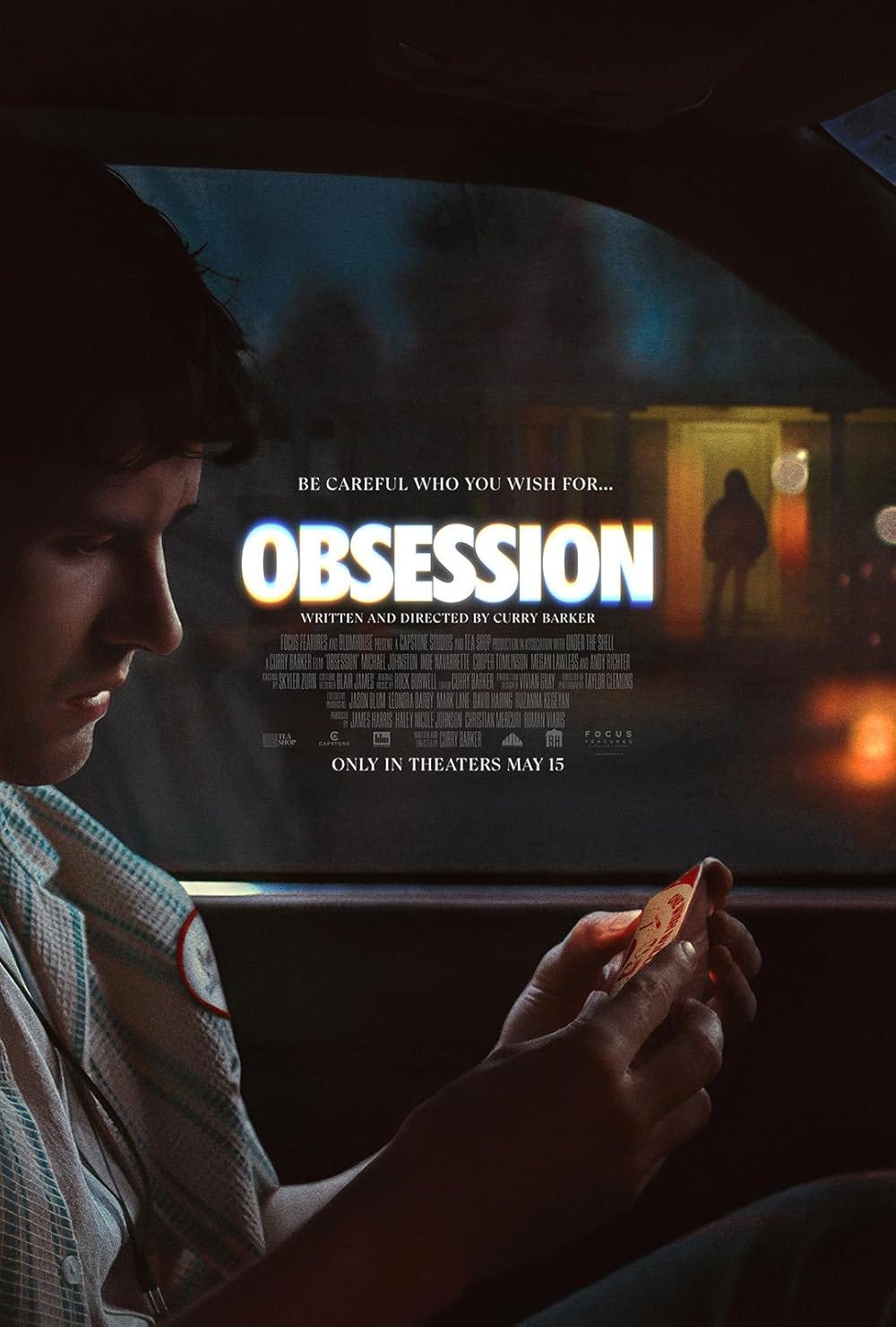

Not totally convinced Curry Barker’s Obsession is prepared to answer for some of its thornier implications, but it’s rare that we get a horror film this gnarly, slick, and mean-spirited. I fucking dug it, and I was fucking terrified.
It’s not just that Inde Navarrette gives an immediately iconic performance as Nikki, but that Barker knows how to play with her disarming smile and silhouette, painting her in as much shadowy darkness as he does blood and vomit. The film ends up speaking a legitimately novel cinematic language, finding the jumpscares within a harrowing form of intimacy, stirring that delicious cocktail of horror, dread, and cringe.
Follow me on Letterboxd at @creid61, and keep up with the rest of my work on Instagram at @coryreid6125.
You can also support my work over at Buy Me a Coffee.